

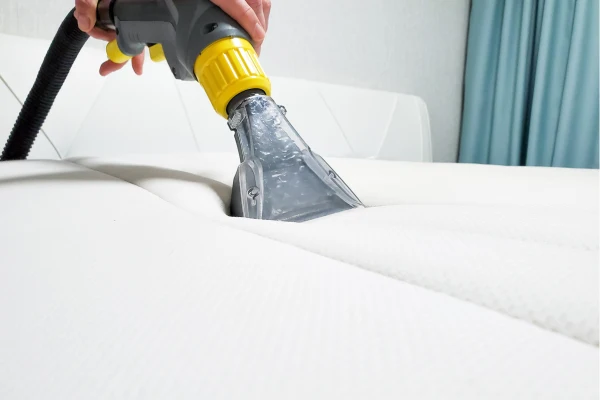
You spend about a third of your life in bed, so it makes sense that your mattress picks up sweat, dust, spills, and the occasional accident, whether it’s a kid, a pet, or a cup of coffee. Most mattresses can be refreshed at home with a few simple supplies, and it’s worth knowing when it’s time to call a pro here in Ames.
Short answer: Strip the bed and vacuum the mattress. Spot treat stains with a small amount of mild cleaner, and use an enzyme cleaner for urine only if your mattress manufacturer allows it. Blot instead of scrubbing. Baking soda can help absorb odor afterward, but it doesn’t dry the mattress, so use as little liquid as possible and let it dry completely before making the bed, because a damp mattress can grow mold.
What You Need
- Vacuum with an upholstery attachment
- Baking soda (for odor)
- Mild dish soap and cool water
- An enzyme cleaner for urine, vomit, and pet accidents (only if the manufacturer allows it)
- 3% hydrogen peroxide for light colored fabric (only if the manufacturer allows it)
- Clean white cloths and towels, and a spray bottle
- A fan
Check your mattress tag or the manufacturer care instructions first. Some brands limit which cleaners you can use, including enzyme cleaners and peroxide, and heavy stains can affect a warranty. When the instructions say no, or you can’t find them, stick to mild dish soap and cool water.
How to Clean a Mattress: Step by Step
- Strip the bed. Take off all sheets, the mattress protector, and any pads. Wash them on the warmest setting the care label allows.
- Check for a removable cover. Some mattresses have a cover that unzips. Look at its care label. Some covers are machine washable, some are dry clean only, and some shouldn’t be removed or washed at all. If it can be washed, follow the label, and make sure the cover is completely dry before you put it back on the mattress.
- Vacuum the whole mattress. Use the upholstery attachment on the top, sides, and seams, where dust and skin cells collect.
- Spot treat stains. Mix a few drops of dish soap in cool water. Dab it on a cloth, not directly on the mattress, and blot the stain from the outside in. Don’t scrub or soak.
- Blot it dry. Press a clean dry towel on the damp area to pull moisture up.
- Use baking soda for odor. Once the surface is no more than slightly damp, sprinkle a thin, even layer over the mattress. Baking soda mainly absorbs odor. It doesn’t dry a wet mattress, so let any damp spot air dry first. Leave the baking soda for several hours, or longer if the mattress smells.
- Vacuum again. Go slowly and remove all of the baking soda.
- Check whether to flip or rotate. Many modern mattresses are one sided and shouldn’t be flipped, and some shouldn’t be rotated either. Follow the manufacturer’s instructions. If your mattress is two sided, repeat the cleaning on the other side.
- Let it dry completely. Run a fan and open a window if you can. Drying time varies a lot with how much liquid you used, the type of mattress, and the humidity. Don’t make the bed until the mattress feels completely dry.
How to Get Urine Out of a Mattress
Speed matters. The sooner you treat it, the less deeply it soaks in.
- Blot up as much as you can with dry towels. Press down, don’t rub.
- If your mattress manufacturer allows enzyme cleaners, test a hidden spot first, then apply a small amount of an enzyme cleaner made for urine, following the label. Apply a small amount to a clean cloth and blot the area, unless the product and mattress manufacturer specifically instruct otherwise. Don’t pour it on. Enzyme cleaners are designed to break down organic residues that can cause lingering urine odor and may work better than ordinary soap alone.
- Blot again with a dry towel.
- Once the surface is only slightly damp, cover the area with baking soda to absorb odor. It won’t dry the mattress, so keep air moving with a fan.
- Let it dry completely, then vacuum the baking soda up. If you still smell it, repeat once or twice with small amounts, and let it dry fully in between.
Avoid hot water, which can set the stain, and never soak the mattress. Old, dried urine is harder, and adding more liquid usually doesn’t help. Extra moisture can push urine deeper and leave the mattress damp inside.
Use the smallest amount of cleaner the label allows, and give the mattress time to dry between rounds. If the manufacturer doesn’t allow enzyme cleaners, stick to a cloth dampened with cool water and a little mild soap, and ask the manufacturer or a professional about the rest. If the smell keeps coming back after a couple of tries, the urine has probably soaked deep, and a professional or a replacement is the safer choice.
How to Remove Sweat Stains and Yellowing
Sweat leaves yellow marks and a stale smell over time. If your manufacturer allows peroxide, and the mattress fabric is light colored, mix a small amount of 3% hydrogen peroxide with baking soda and a drop of dish soap into a paste. Dab it onto the stain, let it sit, then blot with a damp cloth.
Test a hidden spot first, since peroxide can lighten fabric. Skip it on dark or colored fabric, and keep it off memory foam and latex. If the care instructions don’t allow peroxide, or you’re unsure, use mild dish soap and cool water as in the spot treat step.
How to Get Odor Out of a Mattress
Most mattress smells come from sweat, urine, spills, or trapped moisture. Baking soda handles general odor by absorbing it. A layer left for several hours, then vacuumed up, helps. It won’t remove deep odors from soaked material, and it doesn’t dry a damp mattress.
For urine, vomit, or pet smells, an enzyme cleaner may help if the manufacturer allows it, followed by baking soda. Then air the mattress out with a fan and fresh air. Don’t mask smells with sprays, which only cover the odor.
What About Memory Foam Mattresses?
Foam soaks up liquid and dries slowly, so go lighter than you would on a regular mattress. Use a barely damp cloth, blot instead of scrubbing, and never soak it. Many foam mattress makers limit which cleaners you can use, so check the care instructions before using an enzyme cleaner, peroxide, or anything else.
What Not to Do
- Don’t soak the mattress. Moisture trapped inside can lead to mold.
- Don’t use hot water on urine, since heat can set stains.
- Don’t steam clean a mattress unless the manufacturer says it’s safe. Many warn against it because steam can push moisture deep into the layers.
- Don’t mix cleaners, especially bleach with anything else.
- Don’t make the bed on a damp mattress.
How to Keep a Mattress Clean Longer
- Use a washable mattress protector and wash it regularly
- Wash sheets every week or two
- Vacuum the mattress every month or so
- Rotate or flip it only if the manufacturer recommends it, and follow their schedule
- Clean up spills and accidents right away
Ames has plenty of rentals and student housing, so If you’re moving into a place with a used mattress, inspect it carefully before sleeping on it. Check for bed bugs, mold, strong odors, and staining first; routine cleaning is appropriate only if the mattress is otherwise in good condition.
What If You See Mold?
Visible mold, or a musty smell that returns after the mattress has dried, usually means moisture is inside the mattress, and surface cleaning rarely fixes that. Stop sleeping on it. Don’t scrub it, spray it with bleach or other chemicals, or add more liquid. Keep the mattress dry and ventilated, and contact the manufacturer or a professional. Many mattresses with visible mold, especially foam ones, need to be replaced. If anyone in your home has asthma, allergies, or a weakened immune system, don’t handle it yourself.
When to Call a Pro
Home cleaning handles most light dirt, sweat, and fresh stains. Call a professional if:
- Urine has soaked deep or the smell comes back after a few tries
- Stains are large or set in
- The mattress is delicate or hard to clean at home
- You see or smell mold (see above)
- You see signs of bed bugs (call pest control for that first)
Dust and skin cells build up in mattresses over time. For the full picture of why bedroom cleaning matters, see our guide on why mattress and carpet cleaning both matter in your Ames home.
Upholstery and Odor Help in Ames, Iowa
Doug and Renae have run A-1 Carpet Cleaning in Ames since 2004. We clean couches, sofas, and chairs, so take a look at our upholstery cleaning in Ames services. If you have a mattress with a tough stain or smell, call (515) 432-7500 and ask whether we can help.
Frequently Asked Questions
How often should you clean a mattress?
Vacuum the mattress about once a month and wash the bedding every week or two. Use baking soda when the mattress smells stale, rather than on a fixed schedule. Clean it right away after any spill, accident, or illness.
What is the best way to clean a mattress?
Vacuum it, spot treat stains with a small amount of mild cleaner, and blot rather than scrub. Baking soda can help absorb odor, but it doesn’t dry the mattress, so use as little liquid as possible and let it dry completely. Check the manufacturer’s care instructions before using enzyme cleaners or peroxide.
How do you get urine out of a mattress?
Blot up as much as you can right away with dry towels. If your mattress manufacturer allows it, test a hidden spot and apply a small amount of enzyme cleaner made for urine, following the label, then blot again. Baking soda can help with odor once the surface is only slightly damp. Let it dry completely, and don’t use hot water or soak the mattress.
How do you get old, dried urine out of a mattress?
Old urine is harder, and adding more liquid usually doesn’t help because it can push urine deeper and leave the mattress damp inside. If the manufacturer allows it, use the smallest amount of enzyme cleaner the label allows, blot, and let the mattress dry fully between tries. If the smell is still there after a couple of rounds, the urine has likely soaked deep and a professional or replacement is the safer choice.
How do you remove yellow sweat stains from a mattress?
If the manufacturer allows it, mix a small amount of 3% hydrogen peroxide, baking soda, and a drop of dish soap into a paste, dab it on a light colored fabric stain, let it sit, then blot with a damp cloth. Test a hidden spot first, since peroxide can lighten fabric, and skip it on memory foam or latex. If you’re unsure, use mild dish soap and cool water instead.
How do you get the smell out of a mattress?
Strip the bed, vacuum the mattress, and cover it with a layer of baking soda to absorb odor. Leave it for several hours, then vacuum it up. Fresh air and a fan help too. Baking soda won’t remove deep odors or dry a damp mattress. For urine, vomit, or pet smells, an enzyme cleaner may help if the manufacturer allows it, since those smells come from material soaked into the mattress.
Can you steam clean a mattress?
Only if the manufacturer says it’s safe. Many mattress makers warn against steam because steam and hot water can push moisture deep into the layers, where it stays wet and can lead to mold, especially in foam. If the care instructions don’t mention steam, stick to light spot cleaning.
How long does it take for a mattress to dry?
It depends. A lightly spot cleaned mattress may dry in several hours, while one that got more liquid, or a foam mattress, can take a day or longer. Airflow and humidity matter too. Don’t put sheets back until the mattress is completely dry, and If it remains damp much longer than expected or develops a musty smell, keep it ventilated and get advice from the manufacturer or a professional before using it.
Can you clean a memory foam mattress the same way?
Not exactly. Foam soaks up liquid and dries slowly, so use even less moisture, blot rather than scrub, and never soak it. Many foam mattress makers limit which cleaners you can use, so check the care instructions before using an enzyme cleaner, peroxide, or anything else.